
Edible Economics makes me hungry (for change)
Ha-Joon Chang has hacked my brain so I'm thinking about economics whenever I go grocery shopping.
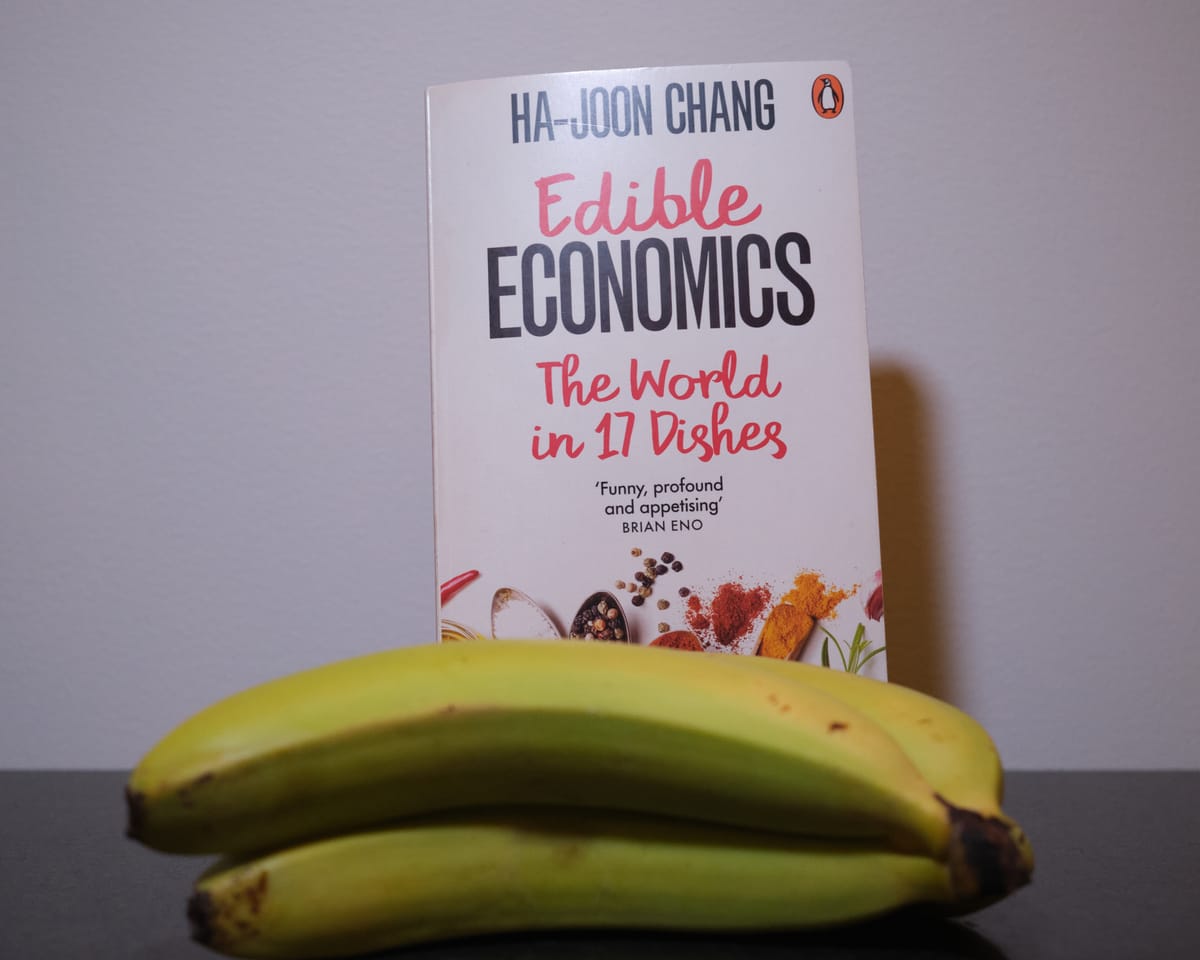
Going bananas
Once I started reading Edible Economics, I couldn't stop talking about it. I wasn't actively thinking about it or anything—although I'm definitely that kind of person, economics and politics do not occupy my every waking thought—but because I kept being reminded about it during ordinary conversations. When a casual lunchtime chat about bananas first reminded me of Chang's mention of banana beer—an instant bucket-list item—and then pivoted the whole discussion onto the topic of banana republics, multi-national corporations, and their effects on host economies, I realized the power of the book's premise.
The layperson's economist
Let's back up a bit. Ha-Joon Chang is an economist from South Korea, and the writer of several books on economics—of which I have read three, including this one. The previous two—Economics: The User's Guide, and 23 Things They Don't Tell You About Capitalism—are stellar, and the former in particular is my go-to recommendation for anyone wanting an introduction to the field of economics.
There are two things about Chang's writing that make him an obvious recommendation for beginners. The first stems from Chang's conviction that everyone should have a grasp of economics, in order to understand the systems that govern their lives. This conviction is clear from the first chapter of Edible Economics, where he addresses the reader:
Are you just going to be 'hanging on in quiet desperation' while you watch the world around you being churned and moulded according to some economic theory that you don't understand? Tell me. Are you comfortable with the way your society is being designed?
Chang is on a mission to teach the layperson about economics, and as a result writes in a way that is accessible, without treating the reader like an imbecile; he isn't giving you an
academic education, he's giving you knowledge to let you understand the world better.
The second thing I appreciate about Chang is that he's a pluralist, drawing freely from different schools of economic thought in his writing. By providing multiple—sometimes conflicting—perspectives, he provides the reader with a broader understanding of economics, and counters the narrative of mainstream (Neoclassical) economics; a narrative that, as Chang writes, "has normalized self-seeking behaviour".
With this in mind, let me tell you how Edible Economics is the best example of these two aspects of Chang's writing yet, and has become my go-to recommendation for an introduction to economics.
This book hacked my brain
Every chapter of Edible Economics is named after a food item, like "banana", "carrot", or "strawberry". Chang starts each chapter with what feels like trivia—like the aforementioned banana beer example, or by explaining the role of lime in aiding British imperial expansion by preventing scurvy—before switching the topic to something more clearly tied to economics.
To me, this structure serves two functions—the first being that it makes for very entertaining segues. When Chang transitioned from an anecdote about unexpectedly spicy food at a restaurant to an explanation of how the long-term economic prospects of women are harmed by the use of GDP as a measure of value, I laughed loud enough to turn several heads on my train to work.
The segues also help tie a topic people don't tend to think much about (economics) to one they think about all the time (food). This makes the economics part easier to understand, and—as exemplified by my lunchtime banana discussion—it's very easy to be spontaneously reminded of what you read.
It's like Chang has pulled an Inception-esque heist in my brain, sprinkling tidbits of economics into neural pathways previously reserved for thinking about dinner. I see carrots in the supermarket and my thoughts swerve to Golden Rice, GMOs, and the ways in which intellectual property law stifles innovation. Someone mentions corned beef, and I think about Uruguay's beef industry, and the complex history of free trade and its ties to colonialism. I think about food constantly, which now means I'm thinking about economics almost as much.
Conclusion
So what's the verdict? In one sentence: go read Ha-Joon Chang's Edible Economics.
The use of food—sometimes as example, sometimes as analogy—to explain the topics of each chapter works wonders to make the subject matter relatable, and embeds the information in your mind in a way that'll bring it to mind during the most mundane conversations. I am in awe of the magic trick Chang has pulled here.
Though I have a few gripes with it—for one, Chang's take on automation comes off as rather out of touch when put into the context of the real world—it is overall a fantastic book on economics; one I'm confident can be read, understood, and enjoyed by nearly anybody.